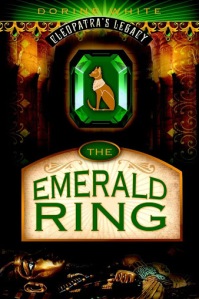
Cover Reveal: The Emerald Ring by Dorine White

I am very excited to host the cover reveal of The Emerald Ring by Dorine White!

The cover reveal of The Emerald Ring by Dorine White

Sara Bogus’s life turns upside down when she discovers an emerald ring that once belonged to Cleopatra. The fun of discovering the ring’s unique abilities turns to fear when she finds out a dangerous cult bent on restoring Rome to power is after the ring. Forced to choose between keeping the ring and saving her friends, Sara learns the price of bravery in this electrifying read!

Barnes and Noble: http://www.barnesandnoble.com/w/the-emerald-ring-dorine-white/1113793929?ean=9781462111336

Amazon: http://www.amazon.com/The-Emerald-Ring-Cleopatras-Legacy/dp/1462111335/ref=sr_1_1?ie=UTF8&qid=1355258432&sr=8-1&keywords=Cleopatra%27s+legacy+the+emerald+ring

A Broken Heart…the story that slips through our fingers

psyche-discovers-that-her-secret-lover-is-cupid 3

Painting: Psyche Discovers That Her Secret Lover is Cupid, Maurice Denis, 1908

Moonlight falls through the window

Spread across your bed

To kiss your shoulder

As you forget

I taste the salt of your skin

You do not stir

Wake up and I will speak

Lover’s words whispered in your ear

But you sleep

Hold yourself above me

The muscles of your shoulder

Tense with your effort to be gentle

Do not be gentle

I kiss you

But you sleep

I memorize the curve of your shoulder

Hold on to the memory

To sculpt it later in my mind

The child’s softness

The man’s resistance

As you sleep

If I were a sculptor

It would be my life’s work

The curve of your shoulder

A gift to the world

A monument

For my kiss

As you sleep

You are a muse

Like a muse, you ask for everything

My everything is too small

One drop of water in a wild ocean

You are Paradise

I am Eve

Quenching my thirst at your tree

You do not make me stop

But you will turn me from Paradise

One seed in the wild earth

Eve is a Goddess

Like a Goddess, she asked for everything

And was expelled from the hearth

She has called me far away

Lured me from the comfort of a home

For a taste of temptation

Salt on the skin of a man

You woke the Goddess

But you sleep

I read there is an angel

Over every blade of grass

Grow, she whispers to the blade. Grow

Grow, I whisper

But you sleep

I have taken a seed from the Knowledge Tree

Hidden beneath my tongue

I plant it with sweat and tears

One seed in the wild world

If I pulled down the wall

The one you’ve built around your heart

What would I find?

You might crumble with the bricks

Fall to your knees at my feet

 I might find there is nothing for me

I do not belong in Paradise

You sigh and I am gone

One seed on a breath of wind

I am on my knees looking up

Your head is thrown back in ecstasy

I own your pleasure

You cannot take it with you

The seed of knowledge

 Temptation

The taste of your skin

As you sleep

If you had felt my kiss

Turned to me

Seen me crumble

Like the bricks

And loved me anyway…

But you sleep

Open your eyes

Find me in the wild ocean

Find me buried in the earth

Find me waiting beneath your Knowledge Tree

Unravel me and spread me across the sky

Like a string of stars

Spread me across your bed

Like the moonlight

But you sleep

I have my monument

You cannot take it with you

Sleep, I whisper. Sleep

And forget your Eve

Censorship…The stories we hide

Image

(Photo above courtesy of flickr user florian.b)

Following is my interview with my friend and local librarian Molly Senechal about the issue of banning or removing certain books from a community. I had intended to weave my conversation with her into a much larger piece, but her words are too well said. No need for any further decoration.

I grew up in Bakersfield, CA, the epicenter for the controversy over The Grapes of Wrath. Even forty years after the book was published, there were still strong feelings over the decision to remove the book from the Kern County Library. As a writer, I know how hard it is to be criticized, to feel I’ve made the offering of a great and perfect gift no one else can see. I have some sympathy for the people in the Bakersfield community who felt John Steinbeck overlooked the good California did for migrant workers. What fires me up, and what interests me from the perspective of a storyteller, is the choice to hide rather than discuss the shortcomings of a story. These are the moments I find so compelling in life! And now…Molly Senechal:

What is your definition of censorship? How have your personal experiences shaped that definition?

I believe censorship is the act of impeding or blocking access to words, stories, music, art, and/or ideas. As far as personal experiences involving censorship go, I have only one: In the early 1980s, the rock band KISS was playing in my hometown. My older brother had tickets to the concert, and our mother forbade him to go. She had heard stories about the band worshipping phallic symbols and other such things. Whether the stories were true, I can’t say. My brother was furious, of course.

Do you think controversy surrounding a book creates more interest, curiosity, or readership?

Controversy surrounding books definitely creates interest. The hubbub over the 50 Shades trilogy by E.L. James is a great example. (See? I’m creating even more interest just by mentioning it here! But that’s because it is a great example of controversy and curiosity.) There are some public libraries that aren’t carrying the series because of its theme and content. People want to know what the big deal is. What’s drawing folks to the book? What’s repelling them? Will they feel the same about the series as their friend (or sister or neighbor or whoever)?

Controversy over a book can be a very beneficial thing. Think about it: You read a book you love, hate or don’t fully understand and you want to “review” it for anyone who will listen — and hear their review(s), too. Heated discussions can even encourage people to read books they might not otherwise touch. I didn’t care for Twilight, but struggling through it inspired me to pick up the granddaddy of all vampire novels: Dracula (which, by the way, I loved).


In a perfect world, how would controversy over a book be handled?

In a perfect world, there would be no controversy over books! Discussion, yes. Debate, yes. Pulling a book from a shelf, no. But since we don’t live in a perfect world, controversy over any art (literary, musical, visual) would best be handled by we, as humans, becoming comfortable with any topic. I really think people censor, or shy away from discussion, because they’re afraid. They’re afraid because they don’t have all the answers, or because they might have to question their beliefs or value systems. Digging deeply into your own mind can be a scary business.

Other thoughts (related to censorship, though perhaps loosely):

Our thoughts are the only things we can control. They are wholly, completely ours. They cannot be restrained, arrested, or withheld. If it’s true that humans are the only animals capable of “higher thought”, why would we limit ourselves by censoring? Why would we limit others’ ideas and ideals? If fear is our motivation (see above), then we need to be braver!

Image

“Ideas don’t die because a book is forbidden reading.” -Kern County librarian Gretchen Knief on the burning of The Grapes of Wrath

Falling in Love…the stories we hold on to

canstockphoto7119110

The Story of Empress Moon

In the beginning, Spirit lived within water. And Spirit wished to know the warmth of the Sun and the smell of the world and the fear of death. Spirit rose into the sky in search of a way to find such adventures and came across Empress Moon, bored on her throne.

“What more might there be to life?” Empress Moon wondered. “What more might I do and see and feel?”

The moon is a windless place, and the heat of the night was enough to scorch the skin. Down below on earth, a pond stretched cool and inviting.

“I will fly down to that pond,” Empress Moon decided. “I will stick one toe in the water and refresh myself. No one will even know I am missing.”

And so Empress Moon took up her cloak of swan feathers and flew down to the earth pond. She put one toe in the water, but it felt so refreshing, that was hardly enough. Before she knew it, Empress Moon stood with both feet in the cool pond.

“How good this feels,” Empress Moon said to herself. I will wade out and stand waist deep in this pond. It will refresh me, and I can get back before anyone knows I am gone.”

So Empress Moon waded out waist deep into the pond. Little fish swam around her legs. A wind moved across her skin and made the surface of the water ripple like a million dancers. She looked up at her home. Everything seemed stagnant and lifeless up on the moon. Here the earth, the pond, so full of life and promise.

“I will stretch out and float on my back in the middle of this pond,” she announced. “It will refresh me, and no one will even know I am missing. I will be back. I must go back, but not yet. Not now.”

Empress Moon stretched herself out over the middle of the pond. She floated on the surface, felt the water ripple along her pale skin. She closed her eyes and sighed and all was good.

But Empress Moon wasn’t the only one whom Spirit had tempted out into the night. King Sun stirred from his sleep with a sense of unrequited passion. He brimmed with a desire to fight or to love in equal measure, whichever met him first. He left his bed and looked down at the earth. He saw a pond that seemed to shine with its own light. It lit the trees and rocks with a magic he could not resist.

“I will go down just for a bit,” King Sun said to himself. “No one will notice if I do. I might hunt at the edge of that pond and rid myself of this restlessness.”

So King Sun flew down and landed by the rock where Empress Moon had discarded her swan feather cloak. When he saw it, he smiled, thinking one of the moon maidens had snuck down to the pond for a swim. He never thought it would be Empress Moon herself. He took up the cloak and cleared his throat.

“Well, isn’t this a fine cloak. What a piece of luck to come across the likes of it so far out in the middle of nowhere.”

Empress Moon startled and jumped onto her feet in the middle of the pond. “That belongs to me. Please, give it back.”

“Finders keepers,” the Sun King shrugged. He turned and stepped into the woods, knowing full well that the maid would follow.

Empress Moon thought to call up the Goddess within herself, but Spirit or some inner knowing all her own stopped her. She tip toed along the tree line after him, as the moon is always apt to follow. When they came to a clearing, she leapt in front of him.

“I will fight you for this,” the Sun King warned. He believed she thought him nothing more than a hunter. She would try to seduce him in order to win back her cloak, and he would enjoy the fruits of her effort.

She did not seduce him.

“I will fight you,” said Empress Moon, “and I will win.”

She smiled.

His blood boiled.

The two ran at one another with a clash that lit up the night. They fought, and the more Empress Moon evaded King Sun, the harder he tried. The harder he tried, the more she smiled. The more she smiled the angrier he grew. The angrier he grew, the more she evaded him. On into the night they fought, first through the trees and then above them, rising higher and higher. The Sun chased, the Moon evaded. The Sun attacked and the Moon countered. On and on and on, until Empress Moon leapt onto the chest of the Sun King. There was dark air above them and dark air below and nothing at all but their two shining figures against the night sky. Empress Moon reached for her cloak. Their fingers touched.

Empress Moon and King Sun fell. They fell through the hot night air, through branches that snapped beneath their weight, through the swish of leaves and the whispered joy of Spirit. Empress Moon and King Sun landed tangled together on the forest floor.

That is when the two truly saw each other. There was suddenly as much interest in the discovery of one another as there had been in their fight. They extended the night long as they could, but it came to pass that King Sun could neglect his work no longer.

The sun and the moon are two different worlds. It was hopeless to believe they could ever be together. They agreed it was best to part as friends and never see one another again. Empress Moon left one way and King Sun the other. They both stepped out of the forest from their opposite sides and could not take one step further from the other. They both stood and waited and could not return to their lives until each had run back to the other and promised to meet just one more night. This need was repeated from one last meeting to the next and might still be this way today if on one night Empress Moon had not been late. While he waited, King Sun swam out into the ocean. When his body touched the line of the horizon, he felt himself begin to sink. Empress Moon arrived. She watched as her lover drowned in the sea.

For a long time, there was no King Sun to light the day. Empress Moon refused to show her silver face in the endless night. Until…

Until Empress Moon felt a tug on her heart that came from deep in the ocean.  She walked to the edge of her world in the sky and looked down at the waves that had taken away her love. She dove. Down and down and down she went, through the dark blue night and the stars. She plunged into the ocean and still she did not stop. Down and down and down until she reached the dark and lonely place where King Sun was captive.

Death asked a bounty for the return of King Sun. Empress Moon gave the silver comb from her hair.

Life asked a bounty for the return of the Sun King’s breath. Empress moon gave her first child, which Life placed on the earth and called Human.

Spirit asked for a bounty for the safe journey to the sky. Empress Moon gave her second child, which Spirit placed in the ocean and called Fin.

Empress Moon took King Sun back to the light where he belonged. Every now and then, the sun and the moon happen to be in the same place at the same time. Empress Moon and King Sun smile at one another, remembering their brief time on earth before they return to their solitary journey through the sky.

The Ancient Art of Growing Up

I used to think the story of Pandora’s Box (see my last blog) was at best a cautionary tale, and at worst another misogynistic version of the dangers of the feminine mind. Like most of our myths, I now believe Pandora resides in all of us. Woman or man. Accountant or artist. Pandora is the true gift of the story, not her box. In fact, the name Pandora means “giver of all gifts.”

Our box is our destiny, and the admonishment not to open it is our call to adventure.

Motivational author Dennis Rodriguez would describe it as the moment when everything changes. In his book, The Super Human Effect, he likens it to the scene in Superman where Clark Kent acknowledges that his gifts were not meant for the cornfield.

In the upcoming weeks, I will create a series that explores the struggle and hope that form the person or community we become. The stories we live by.

In the meantime, check out The Super Human Effect by Dennis Rodriguez.

Giving Thanks…A Toast to Hope, Abundance and the Gift of Our Struggles

Image

Once upon a time, a long time ago, there was nothing on earth but Abundance.

Prometheus, god of forethought, and his brother Epimetheus, god of hindsight, fell in love with the same girl. Her name was Pandora. Each brother had his own strengths and weaknesses, and Pandora was endowed with an ample amount of curiosity. She enjoyed the attentions of both gods.

Pandora’s fun did not last long. Zeus, who also happened to be Pandora’s father, grew angry with Prometheus and sent him away. With Prometheus out of the picture, Pandora enjoyed the spontaneity of life with Epimetheus. The two decided to find a place amongst human kind and shack up.

Before she left, Zeus handed his daughter a beautiful box. He told her she could keep it as long as she never looked inside. When she first set eyes on the glitter of jewels and ornate carvings, the exterior was so lovely that she did not think much about what might be within. Pandora agreed to listen to her father. She crammed the box with the rest of her things and left home for the great, wide world.

When Pandora unpacked, she found the gift from Zeus. What secrets lay hidden inside that box? As soon as Pandora asked herself the question, she had to know the answer.

“I will open it one little crack,” she said to herself. “No one will ever know, and besides, the box belongs to me now. I should be able to do whatever I want with it.”

She kneeled down and popped the lid open just a tiny bit. Only enough for one quick peek. When she tried to close the lid, it would not shut. She pushed and pushed, but something fought her from the other side. The lid opened wider, and out soared Strife and Fear with all our human struggles in tow. They flew across the earth and stole from Abundance wherever they landed.

Frightened, Pandora tried to close the lid, but it flung wide. Out stepped Hope. She flashed a smile and a double edged sword.

“I laugh as I strike,” she said and sailed off to chase after her brothers. So it is as it always has been. Before we had our struggles, we also had no Hope.

“Abundance alone brings heedlessness, thanksgiving gives birth to alertness”

-Rumi

Image

On November 1, 1945, my Grandpa Steve’s A 20 Bombardment Group prepared for a flight over a piece of ocean loosely held by the crumbling Japanese Empire. His orders were to attack the city of Kyushu on the Japanese mainland. If he managed to survive the first wave of his assignment (to fly within radar and give chase to Japanese pilots while simultaneously skip bombing every railroad tunnel), it would have to be done with precision…or there wouldn’t be enough gas to make it back across the ocean.  The mission was so close to impossible, the Army Intelligence officer recommended that Grandpa write his last letter home.

Grandpa Steve never attacked the city of Kyushu, Japan. The planned invasion of the Japanese mainland never took place. America dropped atomic bombs on Nagasaki and Hiroshima instead. As with every war, one government’s collateral damage became someone else’s son…or daughter…or grandmother…or cousin. Japan surrendered.

I once asked my grandpa what he did first when he found out the war was over.

“I got rid of that letter,” he said.

For a long time, I thought it was a shame to lose the history in Grandpa’s letter. I’ve grown up enough to understand the secret places in the human heart we only give away when it’s already too late.

With the war ended, Grandpa transferred from an A 20 to a cargo plane. He was one of the first American servicemen to enter Nagasaki after the bomb was dropped. In fact, he was the pilot who took the Army photographers in circles over the city. Their black and white film captured a deserted wasteland. The history, loss and dead silence where a living, breathing city once stood. Nothing but the hum of the plane’s engine to drown out the emptiness below.

Only a few years earlier, Grandpa Steve had been a teenager in a Texas border town. He helped on the farm, went to school, had a part time job loading grains bags for the railroad and chased girls. His senior year of high school, World War II was still well under way. A man came to Grandpa’s school and asked all the boys if they wanted to take a test to be pilots. Grandpa raised his hand because, as he put it, “it sounded a whole lot better than carrying a gun.”  He passed, and there he was, a wild boy from the Rio Grande Valley turned lieutenant in Japan.

Every chance he got, Grandpa rode the Japanese trains as far as they were working. He carried a little translation book in his pocket. The left side had a sentence written out in Japanese, and the right translated the same sentence in English. If he had a question, he’d open the book, find some sentences close to what he needed to say on the English side, and then find someone on the train and point to the same line on the left. His helper could flip through the book and point to an answer. One day, Grandpa got a little turned around on the trains. He took his translation book up to a young Japanese man and pointed to a sentence about the town he needed to get to. The man handed the book back to Grandpa and answered in perfect English that if he waited four stops, he could transfer to a train that would take him where he needed to be.

Grandpa sat down, and they struck up a conversation. It turned out the man was born in California and had attended the UCLA dental school. When his parents pressed an arranged marriage on him with a Japanese girl, the man traveled to Japan for his wedding a week before the attack on Pearl Harbor.  He was trapped. The Japanese government forced the man into service as a translator, and he wasn’t sure what it had done to his status as an American citizen. He didn’t know if he would ever go home. He was the only local dentist and rode the train for miles every day to help those who needed him.

The US Army was holding his wife’s brother as a prisoner of war on Okinawa.

The man’s wife worried about her brother. They knew the Army allowed care packages for prisoners, but times were desperate in Japan. She feared that if they sent a package, it might never make it to him.

“Do you ever fly to Okinawa?” The man asked.

“I go every week.”

“Could you get permission to take a few things to my brother in law?”

“I don’t need permission. If you meet me at the air base early Wednesday morning, you can take them there yourself. I have the room.”

Sure enough, the man was at the airbase when Grandpa arrived that Wednesday morning. They flew together to Okinawa. The man left for the POW camp and met Grandpa back at the airbase that evening. While they flew home, the man told Grandpa that his wife was very grateful for the kindness he had shown and wanted him to come for dinner. Grandpa explained that it hadn’t been any effort at all. He had the room, and it was easy to help. The man pressed, and the chance to see a real Japanese home was too tempting.

Grandpa followed the man to a house beautiful in its simplicity. They took their shoes off at a door that opened on wood runners and entered a room with a low table set for dinner.

They sat together at the low table. The man talked with Grandpa, but his wife served the food and tea in silence. It wasn’t until the meal was over that the wife whispered something in Japanese to her husband.

“You can’t know how much it means to my wife that I’ve seen first hand her brother is safe. She is very thankful to you for your kindness. She would like to give you one of her kimonos to take back with you to your wife in America.”

Grandpa refused. It had cost him nothing to help.

“For many we are the enemy, and any act of kindness would cost a great deal. My wife is Japanese. She won’t understand if you don’t accept. She will feel dishonored.”

Grandpa followed the man and his wife into a large closet. He sifted through the kimonos until he found one that seemed the most simple. He hope it hadn’t cost too much. The wife pressed it into Grandpa’s hands with a deep bow.

When Grandpa’s service was over, he settled in California with my grandma…less than two hours from the place where the man he met on the train was born. My grandparents had a Japanese American friend over for dinner one night, and Grandpa told him the story of the kimono. The friend asked to see it, and Grandpa brought it out for him.

My grandparent’s friend had been held in an internment camp during the war. It left him painful feelings about those dark days in American history. When he unfolded that kimono, he sat back down and looked at it for a long time.

“So much happened during the war,” he said. “Now I see that the word enemy is faceless, but the word honor is a beautiful, human individual. You did pick her simplest kimono, but not her least important.

“She gave you her wedding kimono.”

Create a free website or blog at WordPress.com.

Up ↑